ARIES Stratosphere Troposphere Radar (ASTRAD)
Click here for ARIES ST Radar (ASTRAD) : Proposal for Observations

Radars have been proven to be excellent and indispensable experimental tool to measure various atmospheric parameters used for basic atmospheric research, weather forecasting and disaster management. In this context, a state of the art Stratosphere-Tropospheric (ST) Radar designed for operating at frequency of 206.5 MHz and installed in the foothills of the Himalayan region at ARIES, Nainital (29.4°N; 79.2°E; ~1800 m amsl) to understand the intriguing aspects of lower atmospheric dynamics over the data sparse region of Central Himalaya. Such high altitude active aperture radar in VHF band (~200 MHz) along with antenna elements over the roof top has been built for the first time in the country.
Major Specifications:
- Operating Frequency: 206.5 MHz

- Bandwidth: 5 MHz
- Peak Power aperture product: 1*10(8) Wm2
- Height coverage: 0.5 to 20 Km (nominal)
- Height resolution: 150 m (typical)
- Horizontal wind velocity: 1 m/s to 70 m/s
- Vertical wind velocity: 1 m/s to 30 m/s
- Velocity resolution: 0.1 m/s to 2 m/s depending on magnitude
- Time resolution: 10 min for full profile (typical)
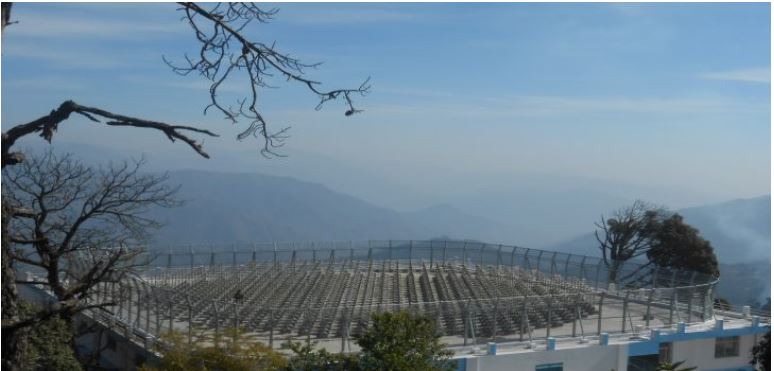
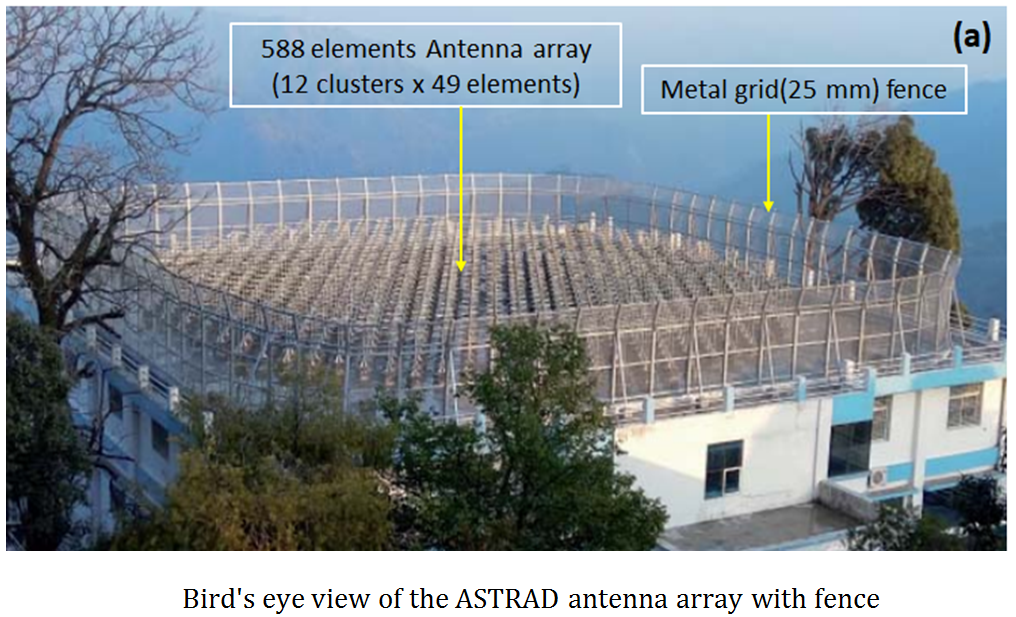
Nainital is considered to be the gateway to the Himalayan region dominated with intriguing dynamical/meteorological aspects such as wind structures, boundary layer characteristics, tropospheric temperature, monsoon troughs, cloud morphology, western disturbances and short/large scale variabilities associated with atmospheric background oscillations. Hence, the ST-Radar system with 588 elements array will provide a deep insight into synoptic processes and mesoscale systems with high vertical and temporal resolutions over central Himalayan region.
1). Jaiswal, A., Phanikumar, D. V., Bhattacharjee, S., &Naja, M. (2020). Estimation of turbulence parameters using ARIES ST Radar and GPS radiosonde measurements: First results from the central Himalayan region. Radio Science, 55,e2019RS006979.https://doi.org/10.1029/2019RS00697.
This study presents the first detailed estimate of atmospheric turbulence over the central Himalayas using the ARIES ST Radar and GPS radiosondes at Nainital. Turbulence parameters were derived using three radar methods and compared with radiosonde estimates from the Thorpe scale. Turbulence was about ten times stronger than in southern India, likely due to complex terrain and mountain waves. Cn² decreased from 10⁻¹⁴ to 10⁻¹⁹ m⁻²/³ with altitude. Radar and radiosonde results agreed well, demonstrating the ARIES ST Radar’s value for improving Himalayan weather and climate models.
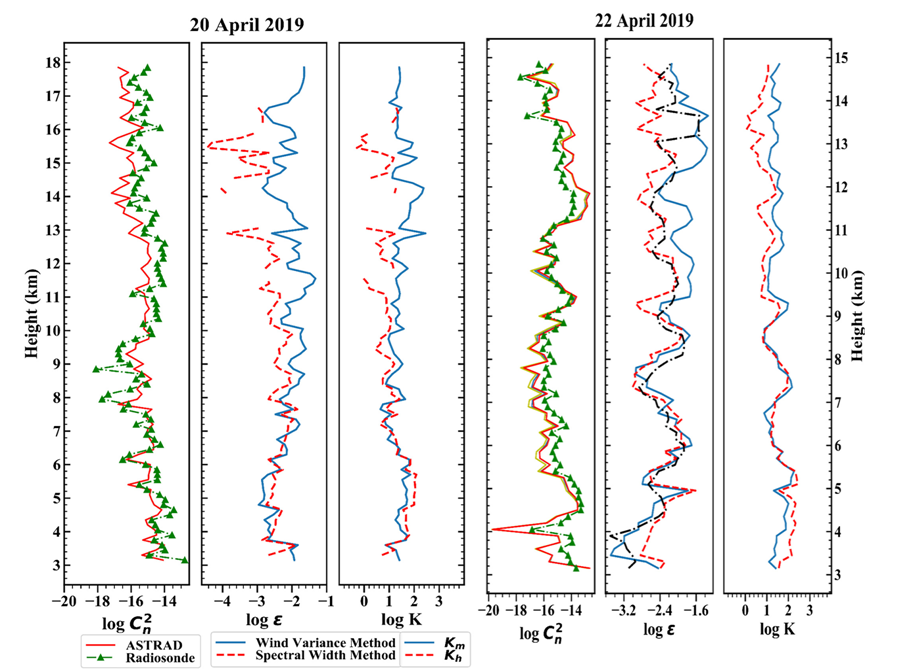
Vertical variations in Cn2 and turbulence parameters on 20 and 22 April 2019.
2.) Bhattacharjee, S., Naja, M., Jaiswal, A., Rawat, K. S., Sagar, R., &Ananthakrishnan, S. (2022). ARIES ST Radar: The first central Himalayan wind profiler. Journal of Astronomical Instrumentation, 11(4), 2240005. https://doi.org/10.1142/S2251171722400050
This paper describes the development of the first 200 MHz VHF active aperture Stratosphere-Troposphere Radar (ARIES ST Radar) at Nainital in the central Himalayas. Designed to operate within a compact building on hilly terrain, the radar provides high-resolution measurements of winds, precipitation, and atmospheric turbulence in all weather conditions. Initial observations detected tropopause heights of 16–17 km and wind reversals. A rooftop metal fence reduces terrain interference. This facility greatly enhances atmospheric research in the data-scarce Himalayas and supports studies of extreme weather and regional climate change.
3.) Jaiswal, A., Naja, M., Bhattacharjee, S., Kumar, B., &Ananthakrishnan, S. (2022). First study of optical turbulence over an astronomical site in the central Himalayas using ST radar observations. Journal of Astronomical Instrumentation, 11(4), 2240007. https://doi.org/10.1142/S2251171722400074
This work presents the first use of a VHF wind profiler (ARIES ST Radar, 206.5 MHz) to measure optical turbulence over Nainital. Using Cn² profiles from 2–20 km, the study estimated key astronomical parameters, including seeing, coherence time, isoplanatic angle, and scintillation. Turbulence was strongest during the monsoon and post-monsoon seasons, while winter and post-monsoon provided the best seeing, with median values of 0.39–0.81 arcseconds. Most daily variations in seeing originated from altitudes of 2–5 km. These results help optimize telescope scheduling, adaptive optics, and high-quality astronomical observations in the Himalayas.
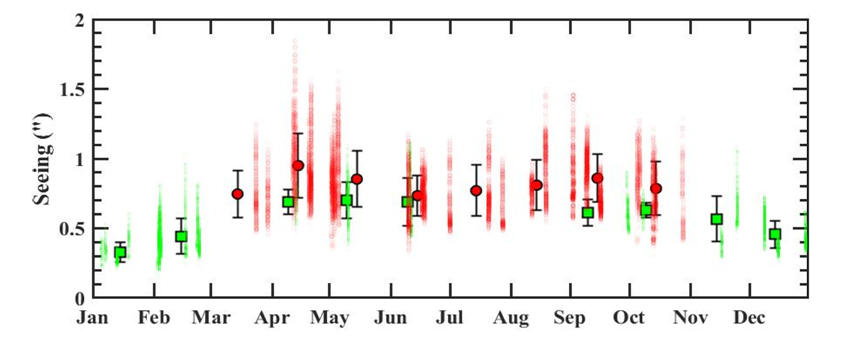
Monthly variations in seeing from ST Radar observations. Green squares and red circles denote better (≤ 0.700″) and poorer (> 0.700″) seeing, respectively; small symbols show individual measurements.
4.) Jaiswal, A., Naja, M., Bhattacharjee, S., Tiwari, S. N., & Reddy, B. M. (2023). Unravelling the dynamics of an intense pre-monsoon hailstorm and summer monsoon deep convective system over the central Himalayas using a VHF radar. Atmospheric Research, 284, 106595. https://doi.org/10.1016/j.atmosres.2022.106595
This study investigates two severe weather events over the central Himalayas using the 206.5 MHz ARIES ST Radar at Nainital. A pre-monsoon hailstorm on 5 May 2020 showed strong supercell features, while a monsoon storm on 2 September 2020 exhibited mixed convective-stratiform rainfall and a double bright band. Both events generated gravity waves that enhanced energy exchange between the troposphere and the stratosphere. The results demonstrate the radar’s ability to capture fine-scale storm dynamics, turbulence, and vertical wind structure, improving severe weather forecasting and disaster preparedness in the Himalayas.
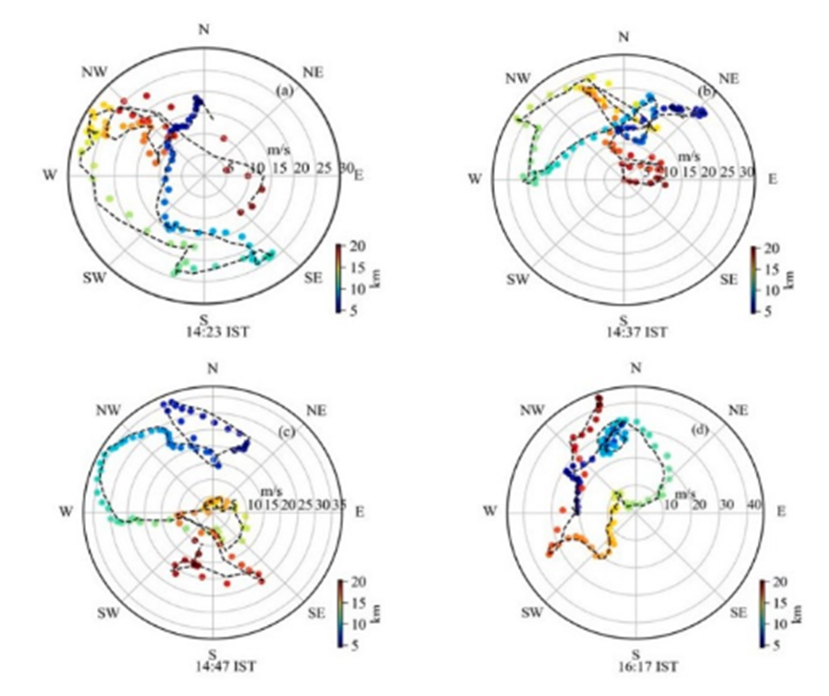
Hodographs of wind profile derived at (a) 1423 IST, (b) 1437 IST, (c) 1447 IST and (d) 1617 IST for Case – 1 (May 5, 2020).
5.) Rajput, A., Singh, N., Singh, J., Kumar, A., & Rastogi, S. (2024). Dynamical and microphysical aspects of two distinct precipitation systems in the Himalayas with 206.5 MHz radar and WRF model. Earth and Space Science, 11, e2023EA003213. https://doi.org/10.1029/2023EA003213
This study investigates the dynamical and microphysical characteristics of two precipitation systems over Manora Peak using the ARIES ST Radar and the WRF model. A monsoon event on 4 August 2020 showed deep convection (10–12 km) with mainly liquid precipitation, while a winter event on 5 February 2021, associated with a western disturbance, had a shallower structure (6–7 km) with both liquid and solid precipitation. Radar observations and model simulations revealed contrasting microphysical processes, demonstrating the value of combining radar and numerical modelling to better understand Himalayan precipitation and improve weather prediction.
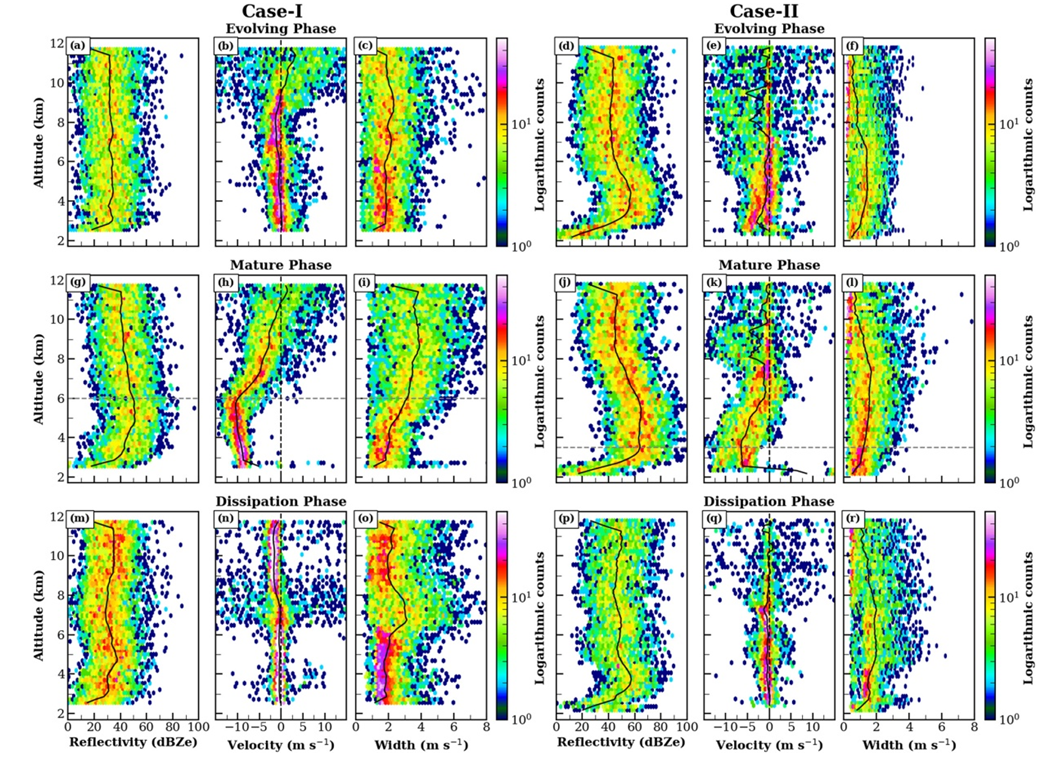
Frequency distributions of Doppler spectral moments during the (a) evolving, (b) mature, and (c) dissipation phases (30 min before, during, and after the event) for Case-I and Case-II. The solid black line shows the median profile, and the dashed gray line marks the 0°C isotherm.
6.) Poddar, N., Das, S. S., Bhattacharjee, S., &Naja, M. (2025). Characteristics of vertical air motion during summer monsoon over the central Himalayan region using 206.5 MHz ARIES stratosphere‐troposphere (ST) radar. Earth and Space Science, 12, e2025EA004232. https://doi.org/10.1029/ 2025EA004232.
This study presents the first observations of vertical velocity during the Asian Summer Monsoon over the central Himalayas using the 206.5 MHz ARIES ST Radar at Nainital. Mean updrafts and downdrafts below 4 km were generally within ±5 cm s⁻¹. A persistent downdraft of about −7 cm s⁻¹ was observed between 10 and 11 km in August. The results suggest that air reaches the stratosphere through a two-step uplift process within the Asian Summer Monsoon anticyclone, improving understanding of monsoon transport and upper-atmospheric circulation.
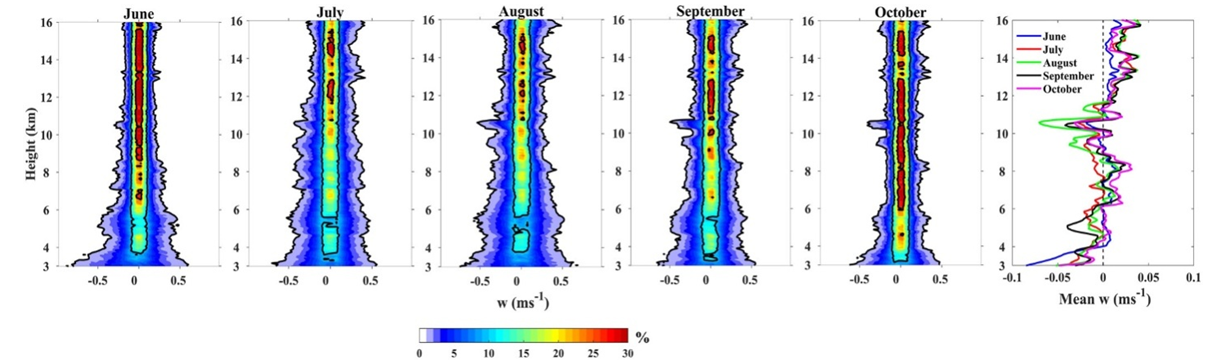
Contoured Frequency by Altitude Diagrams (CFADs) of vertical velocity for monthly composites (June–October) over two years. Black contours indicate 1%, 10%, and 25% occurrence; the right panel shows mean vertical velocity profiles.